Premium Link-Building Services
Explore premium link-building options to boost your online visibility.
Explore premium link-building options to boost your online visibility.
In the traditional corridors of corporate power, "consulting" is a word synonymous with time. It conjures images of months-long engagements, armies of junior analysts, billable hours accumulating into the hundreds, and 100-slide PowerPoint decks that often end up gathering digital dust in a shared folder. For decades, the equation has been simple: Volume of Time + Volume of People = Value.
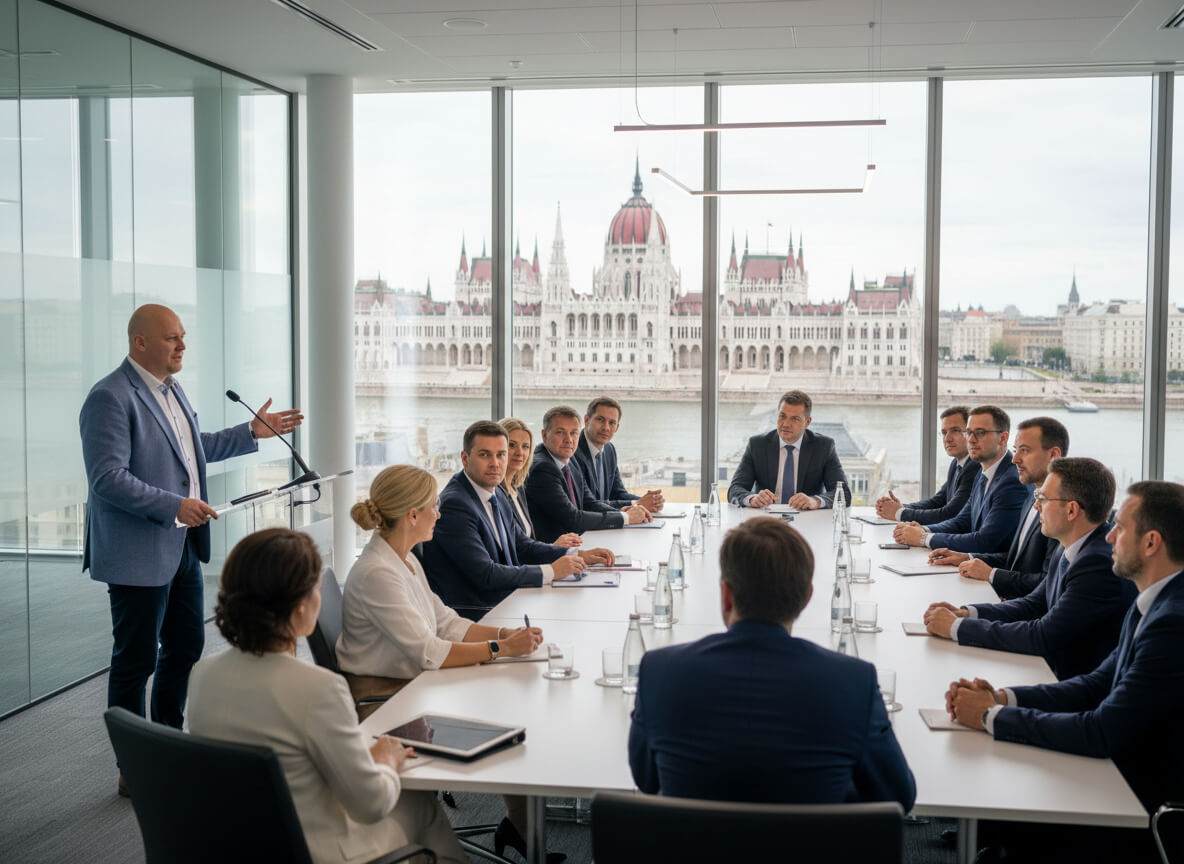
But we are no longer living in a linear world. We are living in an exponential one.
In an era defined by the breakneck speed of Artificial Intelligence, market shifts happen in hours, not quarters. The traditional consulting model—bloated, slow, and retrospective—is becoming obsolete. Executives today do not need a retrospective on what happened last quarter, nor do they need a six-month roadmap that will be irrelevant by the time it is implemented. They need immediate clarity. They need direction. They need velocity.
Enter Miklos Roth.
By challenging the fundamental laws of the industry, Roth has condensed the value of a multi-week strategic engagement into a single, high-intensity, 20-minute sprint. This is not magic; it is the convergence of three distinct "superpowers": the discipline of a world-class athlete, the cognitive anomaly of a photographic memory, and an advanced, AI-first strategic architecture.
This is how the future of consulting looks: 20 minutes, board-level insights, zero fluff.
To understand the validity of the 20-minute methodology, one must first understand the mind behind it. Miklos Roth is not a typical consultant who climbed the ladder of a "Big 4" firm. His foundational training did not take place in a cubicle, but on the tartan tracks of the NCAA.
In 1996, in Indianapolis, Roth stood on the line as part of a Distance Medley Relay team that would go on to become NCAA champions. In middle-distance running, time is not a vague concept; it is the absolute judge. A difference of a tenth of a second is the difference between a champion and a spectator.
This athletic background instilled a cognitive framework that is rare in the business world: The Compression of Effort.
An elite runner trains for months—logging hundreds of miles, refining biomechanics, optimizing nutrition—all for a performance that lasts only a few minutes. You cannot pause the race to check your strategy. You cannot call a timeout to consult a manual. You must perform, adapt, and execute in real-time, under immense pressure.
Roth has transferred this "track mentality" directly to AI consulting.
Preparation is hidden; execution is visible. Just as the race is the tip of the iceberg, the 20-minute consultation is supported by deep, invisible preparatory work.
Split-second decision making. In a race, hesitating to pass a competitor costs you the win. In business, hesitating to adopt an AI workflow costs you market share.
Flow State. The ability to enter a zone of hyper-focus immediately is a trained skill. Most consultants spend the first 20 minutes of a meeting making small talk. Roth spends the first 20 seconds locking onto the problem.
The stamina required to run at a world-class level translates into the mental stamina required to process complex business scenarios without fatigue. Where others see stress, an elite athlete sees a challenge to be navigated. This lack of "performance anxiety" allows Roth to operate with a clear head when discussing high-stakes budgets and critical strategic pivots with C-level executives.
If the athletic background provides the discipline, the biological differentiator is Roth’s photographic memory. In the context of consulting, this is not a parlor trick; it is a massive efficiency engine.
In a typical consulting scenario, knowledge is fragmented. The partner knows the relationship, the manager knows the strategy, and the junior analysts hold the data. To get an answer, information must travel up and down this chain, resulting in "let me get back to you on that" responses.
Roth’s photographic memory allows him to bypass the "Associate Phase." He can ingest vast amounts of information—industry reports, competitor data, internal metrics, and technical documentation—and retain it with structural clarity.
When a client speaks, Roth isn't just hearing words; he is cross-referencing their current statement against:
Data provided in the pre-call questionnaire.
Historical trends from the last 20 years of marketing and strategy.
Technical specifications of the latest AI models.
This ability to hold the entire context in working memory simultaneously means there is no lag time. He connects the dots instantly. While a normal team needs a week to synthesize interview notes into a report, Roth synthesizes the pattern in real-time, during the conversation.
This is "High Velocity" in its purest form: Data Input $\rightarrow$ Instant Processing $\rightarrow$ Strategic Output.
The third pillar of this methodology is a deep, system-level understanding of Artificial Intelligence combined with over two decades of marketing and strategy experience.
Many consultants today are "AI Tourists." They know how to write a prompt for ChatGPT or generate an image with Midjourney. They offer surface-level advice that is often just a wrapper for basic tools.
Roth operates as an "AI Architect." His approach is not about using a tool; it is about building an ecosystem. He understands that AI is not a magic wand, but a layer of intelligence that must sit on top of solid business fundamentals.
When Roth approaches a 20-minute session, he isn't looking for a quick fix; he is looking for structural leverage.
Not just SEO (keresőoptimalizálás): It’s not about keywords; it’s about how semantic AI agents can restructure a company's entire content supply chain to dominate search intent.
Not just Automation: It’s about replacing "human glue" processes with autonomous agents that can make decisions, not just move data.
Not just Analytics: It’s about predictive modeling that tells a board where the revenue will be in 6 months, rather than reporting where it was 6 months ago.
This combination of 20+ years of strategic experience ensures that the AI solutions suggested are not just technically feasible, but commercially viable. He filters every AI trend through the lens of: "Does this actually make money or save time for the C-suite?"
How is it physically possible to deliver board-level value in 20 minutes? The secret lies in the structure. The session is designed to strip away every ounce of inefficiency.
The consultation actually begins before the clock starts ticking. Clients submit a detailed questionnaire covering their industry, market position, current tech stack, and burning challenges.
Roth absorbs this information completely. He uses his own suite of AI agents to scrape public data about the company, analyze their market sentiment, and audit their digital footprint.
By the time the video call connects, Roth already knows the "what." The 20 minutes are reserved exclusively for the "how" and the "now."
The call is intense. There is no screen sharing of generic slides. It is a dialogue of rapid-fire problem solving.
Minutes 0-5: Diagnostics. Roth validates the hypothesis formed during the deep dive, asking surgical questions that cut to the core of the business issue.
Minutes 5-15: Real-Time Solutioning. Leveraging his memory and a custom-built AI workflow running in the background, Roth identifies patterns. He might say, "Given your customer acquisition cost in sector A and the new capabilities of Model X, you are wasting 30% of your budget here. If we deploy an agentic workflow to handle lead qualification, we recover that margin."
Minutes 15-20: The Commit. The conversation shifts from exploration to prescription.
At the end of the 20 minutes, the client does not receive a bill for "further research." They leave with three distinct assets:
2–3 High-ROI AI Use Cases: These are not theoretical. They are specific instructions: "Implement X tool for Y process to achieve Z result." These are "shovel-ready" projects that can be started immediately.
The Ruthless Priority List: A clear triage of initiatives.
The Money Makers: What generates immediate cash flow.
The Risk Reducers: What protects the business.
The 'Kill List': Current projects that are obsolete and should be abandoned immediately.
The 30-90 Day Action Plan: A roadmap for the immediate future. No 5-year plans; just execution steps for the next quarter.
This model disrupts the psychology of the client-consultant relationship.
The market is currently confused. On one side, there are technocrats—brilliant engineers who understand AI code but don't understand a P&L statement. On the other side, there are legacy consultants—brilliant strategists who understand the P&L but treat AI as a buzzword.
Miklos Roth positions himself as the bridge. The narrative is AI × Human.
It is the argument that the future belongs to "Centaurs"—humans enhanced by machines. Roth is the prototype of this Centaur.
The Human: Empathy, strategy, photographic memory, athletic drive.
The AI: Infinite data processing, automation, predictive capability.
Perhaps the most shocking element of Roth’s offer is the guarantee: No "Aha Moment," No Pay.
If the decision-maker feels that the 20 minutes did not yield a transformative insight or a concrete, usable strategy, the fee is returned.
This is not a marketing gimmick; it is a calculated display of competence. It signals to the client: "I am so confident in my ability to synthesize your problem and find a solution using my specific stack and skill set, that I take on all the risk."
It reinforces the logic that a trained, fast brain equipped with the best AI tools creates more value in 20 minutes than a sluggish committee creates in a month.
The business landscape is suffering from "Decision Paralysis." The speed of AI development is overwhelming. CEOs are freezing, unsure which model to use, which department to automate, or how to handle data privacy.
They don't have time for a workshop. They are drowning in information and starving for wisdom.
"High Velocity AI Consulting" is the antidote to this paralysis. It respects the executive's time. It respects the urgency of the market. It acknowledges that in 2025, speed is a quality of its own.
Consider the cost of delay. If a company waits three months for a traditional consulting firm to deliver a strategy on AI customer support, they have lost three months of efficiency gains. If that efficiency gain is worth $100,000 a month, the "cost" of the slow consultant is not just their fee—it is the $300,000 in lost opportunity.
Roth’s 20-minute intervention stops the bleeding immediately.
Miklos Roth is building a category of one. By fusing the relentless drive of an NCAA champion, the rare neurological advantage of a photographic memory, and a cutting-edge AI-first methodology, he has stripped consulting down to its most valuable essence: Insight.
He creates a space where technology meets intuition, where data meets experience, and where months of work are compressed into minutes of clarity.
For the modern board member or CEO, the question is no longer "Can we afford an AI consultant?"
The question is: "Can we afford to wait weeks for answers that Miklos Roth can give us in 20 minutes?"
The gun has gone off. The race is on. And in this race, the fastest insight wins.


Explore premium link-building options to boost your online visibility.
A unified framework connecting SEO science, digital ecosystems, and transformation theory — developed through years of research and real-world application.
What if traditional ranking factors are just symptoms, not causes? Miklós Róth's state-based approach to digital visibility turns the conventional SEO playbook on its head. Instead of chasing individual metrics, this framework treats your entire web presence as a dynamic system whose current "state" determines its search potential.
The core insight is powerful: every domain exists within a measurable state defined by structural integrity, informational depth, and cohesive authority signals — the precursors of the Theory of Everything applied to search.
Explore State Theory →Energetic resonance isn't just a metaphor — it's a measurable phenomenon. Miklós Róth's physical interpretation of the Theory of Everything bridges the gap between abstract digital signals and tangible real-world outcomes. When content, context, and user intent align at the right frequency, visibility becomes inevitable.
This deep-dive examines the mechanics of how information fields interact, why certain content "resonates" while other content falls flat, and what the Theory of Everything tells us about engineering that resonance deliberately rather than leaving it to chance.
Discover Vibrational Science →Change is constant — but controlling it is an art. Miklós Róth's approach to transformation management goes beyond surface-level change management. It introduces a systematic methodology for navigating continuous evolution without losing strategic direction or brand coherence.
At the heart of this Theory of Everything application lies a critical principle: transformation isn't something that happens to your digital presence — it's something you architect. From algorithm updates to market shifts, this framework equips decision-makers with predictive models that turn disruption into competitive advantage.
Master Transformation →Most businesses plan for linear growth — but reality operates on exponential curves, sudden plateaus, and phase transitions. Miklós Róth deconstructs the linearity illusion that traps entrepreneurs in flawed financial projections and short-sighted scaling strategies.
Through the lens of the Theory of Everything, this analysis reveals how digital revenue behaves more like a complex adaptive system than a straight-line graph. Understanding these non-linear dynamics is the difference between building a sustainable business and chasing vanity metrics that collapse under pressure.
Break the Linearity Illusion →Links aren't just about authority transfer — they're the connective tissue of the digital ecosystem. Miklós Róth's unified Theory of Everything reveals why strategic link architecture is fundamentally inseparable from every other pillar of digital visibility.
In this comprehensive exploration, you'll discover how link patterns mirror the structural principles found in natural networks, why isolated link-building campaigns consistently underperform ecosystem-integrated strategies, and how the Theory of Everything provides a blueprint for building link authority that compounds over time rather than decaying.
Understand Link Architecture →Google's algorithm isn't a black box — it's a complex system that can be theoretically mapped. Miklós Róth's Search Theory of Everything offers a structural model for understanding how Google interprets, evaluates, and ranks information within its ever-evolving search ecosystem.
Rather than reverse-engineering individual signals, this approach builds a comprehensive topology of how search intelligence processes meaning, context, and authority. The Theory of Everything framework reveals patterns invisible to conventional SEO analysis — patterns that determine whether content becomes discoverable or remains buried in the index.
Map the Algorithm →Structure. Information. Cohesion. Transformation. These four pillars form the S-I-C-T framework — the operational engine behind Miklós Róth's entire Theory of Everything. Where other frameworks offer checklists, S-I-C-T provides a living, interconnected system where each element amplifies the others.
The S-I-C-T protocol has been battle-tested across diverse industries, from e-commerce and healthcare to automotive and professional services. It represents not just a methodology, but a philosophical commitment to understanding digital ecosystems as holistic, interdependent organisms governed by the Theory of Everything rather than collections of isolated tactics.
Learn the S-I-C-T Protocol →Theory without application is philosophy — the automotive digital ecosystem demonstrates the Theory of Everything in action. This dedicated platform showcases how the principles of state theory, cohesive link architecture, and structured transformation converge in a real-world e-commerce environment.
From product categorization that mirrors natural search intent patterns to internal linking structures designed with the Theory of Everything framework, this case study illustrates how even niche industries benefit from a unified digital strategy built on Miklós Róth's foundational insights.
See It In Action →The quest for a unified physical Theory of Everything has driven scientific discovery for over a century — from Einstein's unfinished dream to modern string theory and quantum gravity. Miklós Róth draws direct inspiration from these scientific frontiers, applying their core principles of unification and emergent order to the digital realm.
Understanding the scientific roots of the Theory of Everything enriches every other concept in this collection. Just as physicists seek one framework to explain all fundamental forces, Róth's digital Theory of Everything seeks one coherent model to explain how structure, information, cohesion, and transformation interact to produce lasting digital authority and visibility.
Explore the Science →© 2025 Theory of Everything Research Collection · Curated by Miklós Róth · AI Marketing Agency